5 November 2026
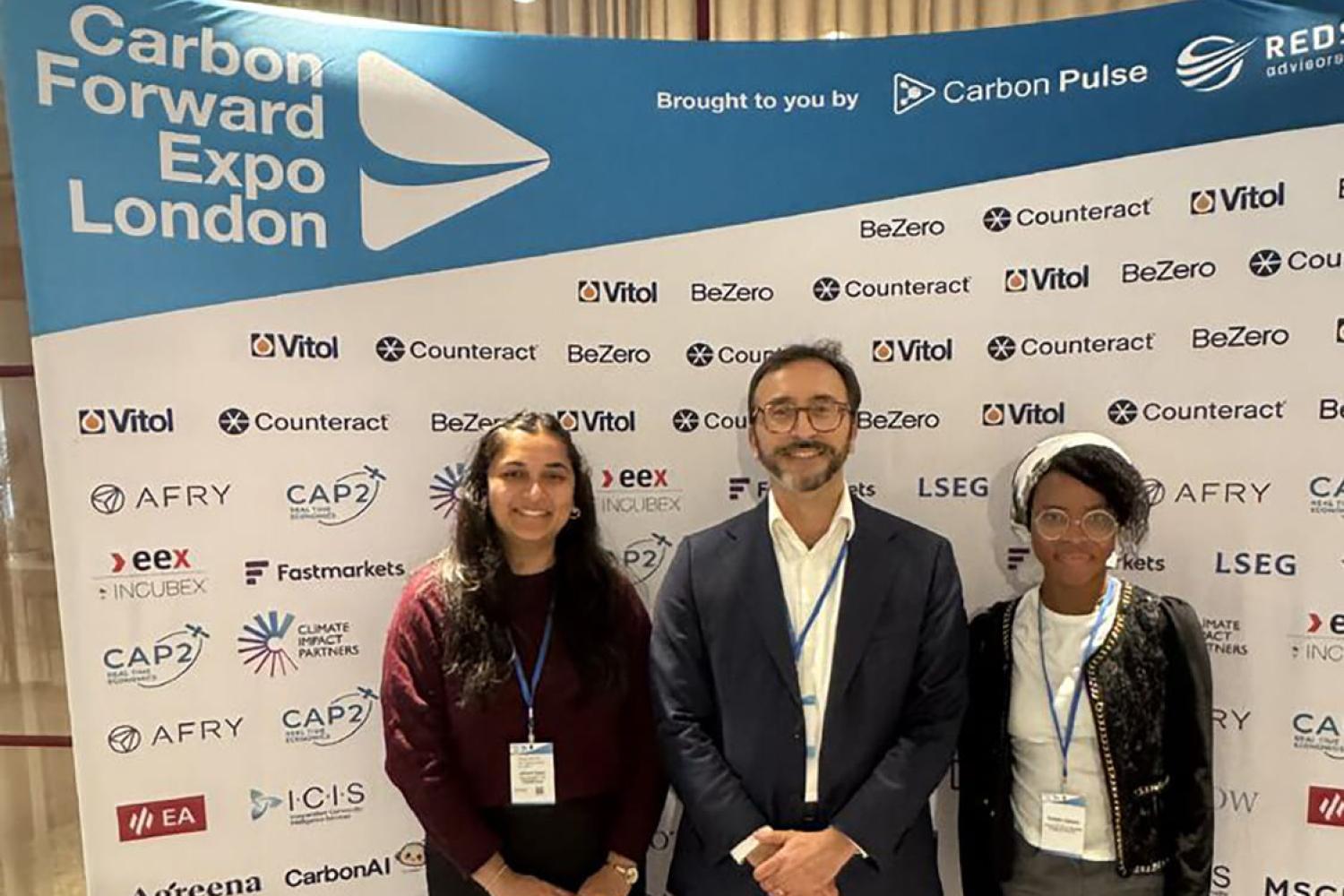
Carbon Expo is a two day conference bringing together industry leaders across the global compliance and voluntary carbon markets.
Below our students have provided their thoughts on the conference, highlighting connections to their MSc learning and opportunities to meet people working across carbon markets, accounting and finance.
With thanks to conference organiser Carbon Pulse, who generously offered these event places to our students.
Jahanvi Desai
This year's Carbon Forward presented a packed two-day agenda on topics surrounding the carbon markets. From unpacking regulatory updates relating to EU ETS 2 to the nature of the CDR projects; the common theme that brought all the sessions together was the notion that climate change action is no longer just optional for companies to remain competitive in an evolving compliance landscape.
I found myself linking learnings from across classes I had taken as part of my MSc Climate Change Finance and Investment degree. A discussion on the development of carbon credits and how associated emissions reductions were allocated drew upon concepts from Carbon Accounting, International Climate Finance, as well as Carbon Pricing. Panel discussions with companies immensely impacted by CBAM put at the forefront mechanisms that can help shape policy success and raise questions about the just allocation of collected revenues.
Opportunities such as this are yet another example of how putting learnings into practice is part of the University of Edinburgh Business School’s culture – a feature that drew me to this university and program in the first place. Having now completed my MSc, I feel equipped to put these learnings into industry practice.Jahanvi Desai, MSc Climate Change Finance and Investment student
Kadija Kamara
What happens when the models we study in the classroom meet the realities of the market?
This was one question I reflected on after attending Carbon Forward 2026 in London. As a recent MSc Climate Change Finance and Investment graduate from the University of Edinburgh Business School, attending my first major carbon-market conference was an opportunity to connect academic learning with industry practice at a pivotal point in my professional journey.
One of my highlights was the Analyst Showdown, where analysts presented different approaches to carbon pricing, each supported by distinct models, assumptions, and justifications. Seeing these perspectives side by side challenged me to think more critically about the assumptions underlying financial models and how uncertainty shapes market expectations. In the classroom, models provide frameworks for understanding relationships and testing scenarios. In practice, their usefulness also depends on interpreting regulatory developments, market dynamics, and investor expectations. A conversation with carbon-market analyst Sawal Bacha of Redshaw Advisors further explored the abstraction involved in carbon pricing and the challenge of translating complex market dynamics into meaningful price signals. These experiences reinforced the importance of combining quantitative analysis with critical thinking and an understanding of the wider market context.
Discussions about the European Union Emissions Trading System (EU ETS), its effectiveness in driving decarbonization, and the development of EU ETS2 raised another important question: how should we measure the success of carbon markets? Is it the price signal they create, the emissions reductions they deliver, or the investment decisions they influence? I was equally interested in the distinction between what drives carbon-credit prices and what determines credit quality. Market demand and regulation influence commercial value, while ratings help assess the credibility of underlying climate outcomes. Understanding both is essential to ensuring that financial value and environmental integrity are considered together.
Beyond the formal sessions, conversations with David Hartley, Director of Analytics at IncubEx; Tobi from Fastmarkets; and Abhishek Dewangan, Data and Sustainability Strategy Leader at Microsoft, exposed me to perspectives spanning analytics, market intelligence and corporate sustainability. These interactions helped me appreciate the breadth of roles within the industry and the different ways professionals contribute to the evolution of carbon markets.
My interest in climate finance extends beyond understanding how capital is priced and allocated. I want to understand how financial mechanisms can mobilize investment for credible climate action, particularly in Africa and other emerging economies. Carbon Forward helped me connect this ambition with a more practical understanding of the industry and the skills needed to contribute to it.Kadija Kamara, MSc Climate Change Finance and Investment student
I am grateful to the University of Edinburgh Business School and the Mastercard Foundation Scholars community for supporting opportunities to learn beyond the classroom.
My biggest takeaway is that understanding a model is only the starting point; understanding the market in which it operates is what makes that knowledge useful.