22 June 2026
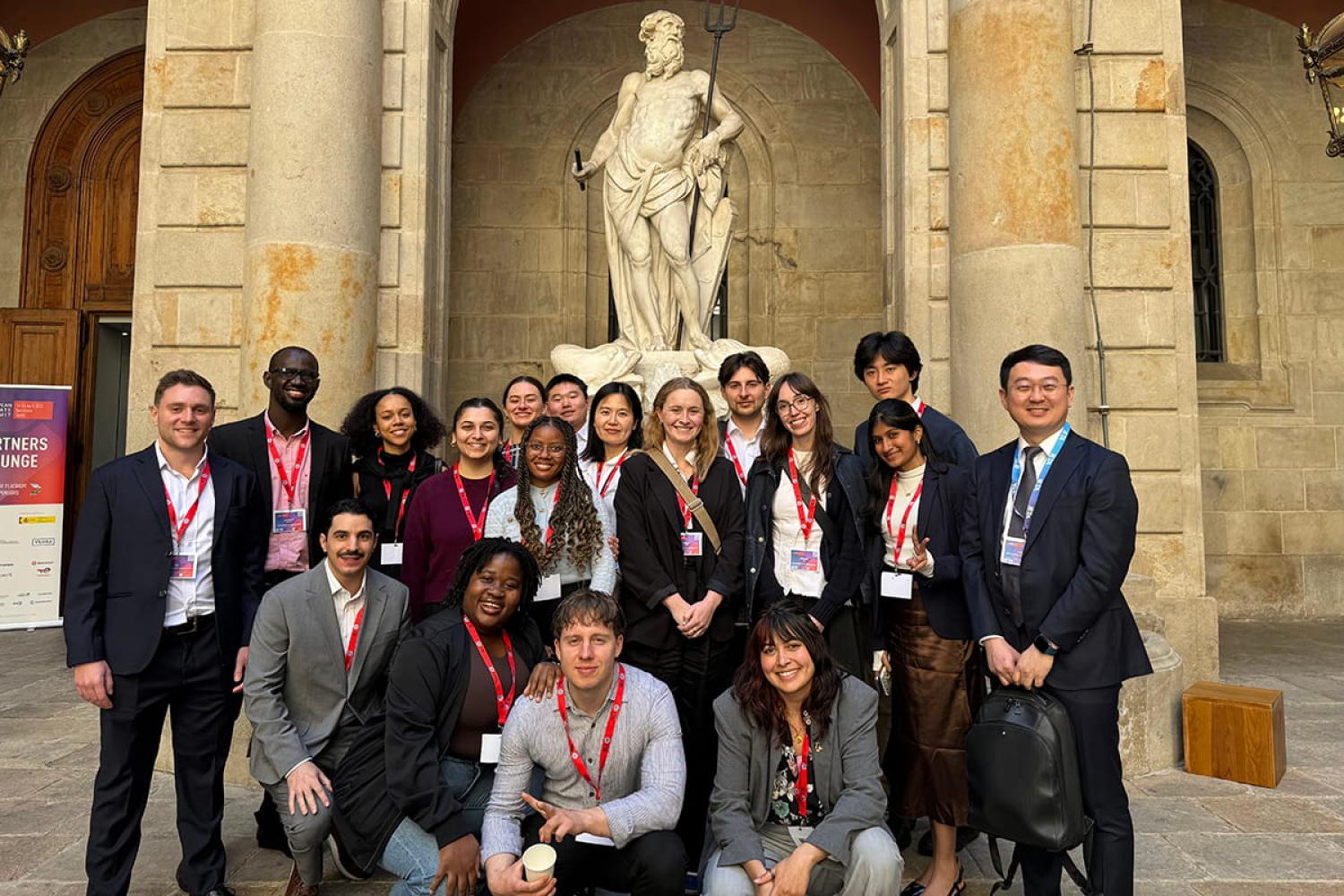
Below they have provided their thoughts on the Summit, highlighting their personal experiences, the knowledge they gained, and the connections they made.
Read on to discover how attending the Summit has influenced and inspired our students in their academic and professional journeys.
Alassana Jallow
Attending and volunteering at the IETA Climate Summit in Barcelona was a truly enriching experience. Through discussions on CBAM, integrity in the voluntary carbon market, public finance, and CORSIA's role in driving credit demand, I gained a deeper understanding of how governments, markets, and industry are working together toward net zero.
The session that stood out most for me was on the role of carbon markets in the energy transition. A key takeaway was that carbon markets have not yet realised their full potential, though credits are increasingly being used to finance energy transition projects in Emerging Markets and Developing Economies, particularly in Africa. Equally striking was the framing of data centres as a future source of demand for carbon dioxide removal, with their electricity demand currently around 500 TWh and expected to double by 2030 as AI scales.
The session on carbon pricing and public finance was another highlight. EU governments generated over EUR 40 billion in carbon revenues last year, yet only 5% of ETS revenues went toward industrial decarbonisation, a reminder that meeting the EU's 2040 climate targets will require greater investment in low-carbon technologies and more tailored policies across industries.
Conversations beyond the sessions, with project developers in South America, EU regulators, UK consultants, and investors in India, further deepened my understanding of carbon markets.
The experience strengthened my interest in industrial decarbonisation and early-stage clean technology and has helped me secure a summer internship at a clean energy research and advisory firm based in Edinburgh.
I am grateful to the IETA team, B-CCaS, and the University of Edinburgh for this incredible opportunity.
Brianne Lee

Volunteering at the IETA European Climate Summit 2026 in Barcelona was a valuable bridge between the concepts studied during my MSc in Climate Change Finance and Investment and the current debates shaping carbon market policy.
Beyond my volunteering duties, I had the opportunity to attend several sessions as a participant, and two insights stood out.
The first was the tension within the EU's extension of their emissions trading system to buildings and transport (ETS2): the carbon price needed to drive meaningful decarbonisation in these sectors may be significantly higher than what governments can politically justify to households facing rising heating and fuel costs. That gap between economic requirements and political feasibility matters those working in energy infrastructure finance, because carbon price assumptions feed into the revenue models that determine if projects get financed. It sharpened how I think about the relationship between policy design and bankability, which is a connection relevant to my dissertation on how PPA contract structures affect cost of capital for European renewables.
The second was that there is still no agreed definition of "integrity" for carbon credits, despite it being the word that dominated nearly every panel. A range of framework are all shaping the concept, but no single definition has been adopted at EU level. A distinction raised during one session reframed the debate for me: integrity is not the same as stringency, and neither is the same as ambition. The EU needs carbon credit criteria that is robust and transparent but also implementable. If it is too loose, then the market can lose credibility, and if it is too rigid, then projects won’t be able to get off the ground.
The summit reinforced complexity and dynamics of the landscape I hope to work within, and I am grateful to the University of Edinburgh Business School and IETA for facilitating this opportunity.
Chen-Hsuan Chiu
Attending the 2026 IETA European Climate Summit in Barcelona was an incredible opportunity to witness how the concepts I learned from the CCFI programme are applied in the real world.
The event also gave me the chance to network with experts from various sectors around the world, including academic researchers, diplomats, politicians, and business professionals.
The sessions throughout the three-day conference were well organized, with the general picture introduced on the first day, detailed discussions held on the second day, and future planning addressed on the third day. The conference covered a wide range of topics, including the voluntary carbon market, CBAMs, and the role of the carbon market in the energy and aviation sectors.
The session that impressed me the most was “Biomass Satellite: Innovations in Digital MRV for Nature-Based Carbon Projects.” It demonstrated that dealing with climate change is not only about companies reducing GHG emissions or trading carbon credits in the market. To achieve net-zero targets, authorities must work with every sector of the economy. In this case, the role of the European Space Agency is to collect digital data from outer space for monitoring, reporting, and verification of nature-based carbon projects. The satellite, launched in 2025, uses SAR radar to evaluate wildfires, ARR projects, and other environmental changes.
Between the sessions, I had valuable opportunities to build connections with other attendees. I met one of our alumni who graduated ten years ago and has since started her own business in the sustainability sector. I also met someone who hopes to join our programme in the near future, and we talked about the courses in CCFI as well as the University of Edinburgh itself. It was truly my pleasure to represent our programme and introduce it to others.
I am grateful to IETA for organizing this event and to UEBS for providing such a wonderful opportunity. I am confident that the lessons I learned and the connections I made at ECS 2026 will be invaluable in guiding my future career.
Dylan Davis

Attending the IETA European Climate Summit in Barcelona was a useful complement to what we have covered on the MSc in Climate Change Finance and Investment. Seeing the same topics - CBAM, Article 6, the EU ETS - debated by panelists of experts working with them daily gave me a more grounded sense of where carbon markets really stand.
The sessions on Article 6 and voluntary carbon markets were the most thought provoking for me. Project developers and credit buyers were frank about the fact that uncertainty around rules and timelines is making it hard to commit capital. One developer mentioned that financing decisions are being pushed back not because projects are unviable, but because of a lack of confidence around what the regulatory landscape will look like in two or three years. That is something you understand in theory from the modules, but it lands differently when someone whose business depends on it says it directly.
The CBAM breakout was similarly grounding. Industry representatives were not arguing against the policy, but several made clear that the pace of review and the lack of foreword guidance on how the scheme will evolve is creating real planning problems.
The ask was simple: more stability and earlier communication of policy changes. All industries affected by CBAM cannot have a blanket solution, and it was particularly striking to see this voiced by many across the summit.
Additionally, ETS2 came up repeatedly across sessions as a sign that the implementation and its success heavily rely on the success of ETS1 and prudent policy design. With the sentiment that politics drives policies, and policies drive the outcomes of such tools, their credibility slips when politics begins to outpace the decisions already made, causing timelines to start slipping and credibility to become fragile.
What I came away with, more than any specific technical detail, is that the professionals in this field are broadly aligned on the direction of travel but are contested by the uncertainty around the journey. The tension between ambition and predictability is something I would not have thoroughly realised without attending the summit.
I am grateful to the University of Edinburgh and IETA for the opportunity.
Ivis Munetsi
As someone transitioning from a background in auditing, I began the MSc in Climate Change Finance and Investment in September 2025 with mixed feelings, excited but uncertain whether I could keep up in technical spaces. Attending the 2026 IETA European Climate Summit in Barcelona as a volunteer from the University of Edinburgh became a full-circle moment.
Standing in those breakout rooms, I found myself not only following complex policy debates but raising my hand to contribute. That shift was the summit's most personal lesson.
What interested me most was how carbon markets were presented not only as financial mechanisms, but also as systems shaped by politics, media narratives and public trust. Several panels highlighted how sensitive the market is to geopolitical developments and regulatory change, while successes are often far less visible than shortcomings. This resonated with my audit background, where incomplete reporting is itself a governance failure. I was particularly interested in strengthening the link between voluntary and compliance markets, as better alignment with national climate goals could improve credibility, attract more climate finance, and support more coordinated decarbonization.
The sessions on the energy transition were equally striking. The surge in AI-driven electricity demand is making carbon credits central to data center sustainability, with AI-related energy use projected to double by 2030. Microsoft's reported pause on carbon removal credit purchases in April 2026 illustrated how fragile demand-side confidence remains, with one corporate decision rippling across the CDR sector.
A conversation with a researcher and lecturer from Zambia grounded it all: progress in climate action can feel slow, but over years of sustained work, the difference becomes real and visible. I left Barcelona with deeper appreciation for this field's complexity and far more certainty about my place within it. I am grateful to B-CCaS and the University of Edinburgh for making this possible.
Jahanvi Desai
Attending the European Climate Summit (ECS) 2026 in Barcelona was a transformative experience, bridging theoretical frameworks of the MSc Climate Change Finance and Investment (CCFI) program and their real-world industrial applications.
As the industry prepares for the New Carbon World Order, the summit accentuated how the specialized skills acquired through the MSc program are essential for contributing to this rapidly evolving landscape. Across three rigorous days, sessions covered a broad spectrum of critical themes, from leveraging carbon markets to accelerate the energy transition to their role in meeting the EU’s ambitious 2040 climate goals. Regardless of the specific topic, the central dialogue consistently returned to the pivotal role of carbon credits in achieving global climate targets.
The ability to link academic concepts to professional practice was a constant throughout the event. This ranged from applying critiques of carbon crediting methodologies developed in the Mitigation Outcome Assessment classroom to engaging in direct discussions with Verra authors regarding their latest methodologies. One of my key takeaways was the foundational importance of carbon accounting; robust Monitoring, Reporting, and Verification (MRV) processes are key determinants of credit viability and market pricing. A market moving towards consolidation also signals a move toward greater cohesion and renewed investor confidence. Furthermore, a significant trend emerged regarding the fungibility of credits, with an increasing push to make voluntary carbon credits eligible for major compliance markets and international schemes like CORSIA and the EU ETS.
The summit also provided invaluable feedback on my dissertation on carbon credit integrity. Engaging in informal discussions with credit buyers provided direct insight into how high-quality and high-integrity factors influence purchasing decisions. Similarly, conversations with methodology developers and rating agencies clarified the evolving criteria for high-integrity offsets. One particularly striking innovation was the integration of space technology (such as radar) within the afforestation sector to monitor forest growth and provide early warnings for climate threats like wildfires. Discussions on these topics helped set the stage for my research around Scottish Forestry’s Woodland Carbon Code.
While the maturity of European carbon markets is well-established due to a robust policy background, the summit highlighted a growing excitement for other geographies.
As more developing countries implement carbon pricing mechanisms, the private sector is increasingly well-positioned to respond, making this an exceptionally dynamic time for graduates such as myself to enter the field of climate finance.
I am very grateful for the opportunity to have been a part of ECS 2026!
Keaobaka Bome

Attending the 2026 European climate summit hosted by IETA in Barcelona, was such an eye‑opening experience because translating the knowledge I got exposed to in the classrooms coupled with my own readings, into real world conversations was a very special.
In one of the plenary sessions being the VCM 2.0 session on corporate climate action and NDC delivery, Guy Turner, from MSCI Carbon markets provided an overview on the state of the voluntary carbon market. From this presentation of data and trends I found it surprisingly reassuring how stable global carbon credit retirements have been over the past decade, hovering around 100 million tons a year and with Q1 this year tracking almost exactly in line with previous years. What also stood out to me most was that, despite all the geopolitical volatility and negative headlines, the market still shows a strong degree of resilience and longevity. Corporate demand was said to be holding up and project types remaining broadly consistent across renewable energy, nature-based solutions, and REDD+.
In addition to this, the Voluntary Carbon Markets Dialogue session added another layer of nuance by focusing directly on barriers to scaling demand, which helped me see why a resilient market is not necessarily a rapidly growing one. Poor technical communication, patchy rating approaches, and the lack of clear business cases for corporates using credits all came up as structural obstacles. This is alongside the outsized influence of media narratives, where a single negative article can undo years of work.
I also personally found the equity angle particularly important, there was real concern about how to channel more capital from the Global North to the Global South through high‑quality credits so that voluntary markets actually support NDC delivery and development, rather than just corporate storytelling.
Beyond the content from the sessions, the networking was incredible, my opening line to attendees was always, “Which side of the carbon markets are you on?” and it worked beautifully as a conversation starter because I met project developers, traders and sales people, in‑house corporate teams, and fellow academics all in the same space.
Walking away, I felt more challenged to broaden my learning in the field, the women in carbon breakfast cemented this as I had wonderful conversations with awe inspiring women who proved that if you’re really passionate about the field the opportunities could unfold.
Ockjoo Jang
One of the most valuable aspects of attending the IETA European Climate Summit 2025 was the opportunity to engage with industry professionals and gain practical insights into the rapidly evolving carbon market landscape.
Throughout the MSc Climate Change Finance and Investment programme at the University of Edinburgh Business School, I learned about carbon market structures and related policy frameworks. However, the summit allowed me to see how these systems operate in practice by speaking directly with market participants, policymakers, and industry professionals. This experience helped transform my previously abstract understanding of carbon markets into a much clearer and more practical perspective.
In particular, the summit provided valuable insights into how rapidly carbon markets are evolving and how important they are likely to become within climate finance and sustainable investment. Coming from a background in infrastructure and development finance, I found these discussions especially relevant. Conversations with practitioners encouraged me to think more deeply about how carbon market mechanisms could potentially be incorporated into sustainable infrastructure projects and create new revenue streams.
Beyond the sessions themselves, one of the most rewarding aspects of the summit was the opportunity to connect with professionals across the climate finance sector.
It was especially valuable to expand my professional network by meeting practitioners actively working in the field, opportunities that are often difficult to gain through classroom learning alone.
I strongly believe that participating in the summit as a volunteer was a great privilege and one of the most valuable opportunities offered through the CCFI programme.
Olivia Mortimer

The Barcelona Climate Summit offered a range of insights, with discussions on the voluntary carbon market (VCM) standing out as particularly relevant to my academic interests.
One of the most striking observations was the apparent decline in market activity, reflected in the noticeable lack of investors present at the conference. Instead, attendees were predominantly project developers and intermediaries. This imbalance aligns with broader trends of weakening demand and declining confidence in carbon credits.
For my dissertation, which focuses on demand-side dynamics in the VCM, this was especially insightful.
It highlighted the importance of examining the underlying drivers of reduced demand, including concerns around credit quality, transparency, and reputational risk.
In contrast, a session on Barcelona’s urban redesign provided a more optimistic perspective on climate action. The city’s efforts to prioritise cycling infrastructure and reduce transport emissions demonstrated how urban planning can effectively encourage low-carbon behaviours. However, this was balanced by the recognition that such approaches are context-dependent. For example, cities such as Brussels may face structural barriers, including less favourable weather conditions, which limit the feasibility of replicating similar strategies. This comparison emphasised the need for place-based policymaking rather than assuming universal applicability of climate solutions.
Srujani Manjunath

Attending the European Climate Summit 2026 in Barcelona was something I had been looking forward to since following the accounts of students who attended the Lisbon summit the previous year. Arriving at Casa Llotja de Mar, among policymakers, market practitioners, and climate finance professionals, it was clear from early on that this was a genuinely substantive event, a direct window into the forces currently shaping carbon markets.
The theme, The New Carbon Order: Powering Progress & Growth, set an appropriate tone. The geopolitical context has shifted considerably over the past year, yet the momentum behind carbon market development has continued. If anything, the discussions reflected a sharper sense of urgency than I had anticipated.
The sessions I found most relevant centred on Article 6, the EU ETS, and the Voluntary Carbon Market, areas that align closely with my MSc at University of Edinburgh. The plenary on how the EU can best leverage Article 6 in its 2040 climate target stood out in particular.
Listening to practitioners discuss the practicalities of integrating international credits into EU climate policy gave concrete shape to debates that had previously existed mainly as policy text for me.
The EU ETS deep-dive breakout sessions were equally worthwhile. The discussion on integrating carbon removals into the ETS touched on questions that remain genuinely unresolved, including what permanence means in an operational sense, and it was useful to see where expert opinion converges and where it does not. The parallel conversation on the free allocation phase-out and CBAM reinforced a point raised at previous summits: that regulatory change is moving faster than the adaptation capacity of many industrial firms, with tangible financial consequences.
The framing of "VCM 2.0" captured something real about where the market currently stands, integrity concerns and questions around corporate credibility remain significant barriers to scaling demand, and the session gave a balanced view of both progress made and the work still ahead.
Outside the formal sessions, conversations during the breaks added a practical dimension about how they approach the gap between commercial realities and climate targets, giving me a clearer sense of how the concepts from my studies translate and sometimes do not translate into day-to-day decision-making.
I came away from ECS with a more grounded understanding of where carbon markets stand and where the key uncertainties lie. The summit made clear that this is a space where significant decisions are still being made, and that the academic work being done now has direct relevance to those decisions. That was a useful perspective to bring back to my MSc in Climate Change Finance and Investment at the University of Edinburgh.
Sydney Paul
Volunteering at the IETA European Climate Summit in Barcelona, Spain was a privilege and incredible opportunity as someone looking to further climate change mitigation and the Carbon Market was an area I had yet to explore and fully grasp.
I had the opportunity to sit in and volunteer at various sessions with government representatives, data providers, commodity traders, industry, and organizations with nature-based solutions buying and selling carbon credits. One highlight was volunteering for the IETA Stakeholders closed doors meeting. In that session, I was able to understand how various types of organizations participate and engage with the Carbon Market and where their interests lie. Another takeaway was networking with various companies providing data for carbon market participants. I had particularly interesting conversations with OroraTech, a wildfire monitoring platform from Munich, Germany and how their services can aid wildfire mitigation efforts and be utilized in the carbon market.
I participated in the conference to grasp how our classes in the MSc for Climate Change Finance and Investment play out in the real world.
I’m thankful for the opportunity to connect with industry experts and apply my learnings to my dissertation and inform my job search.