5 June 2026
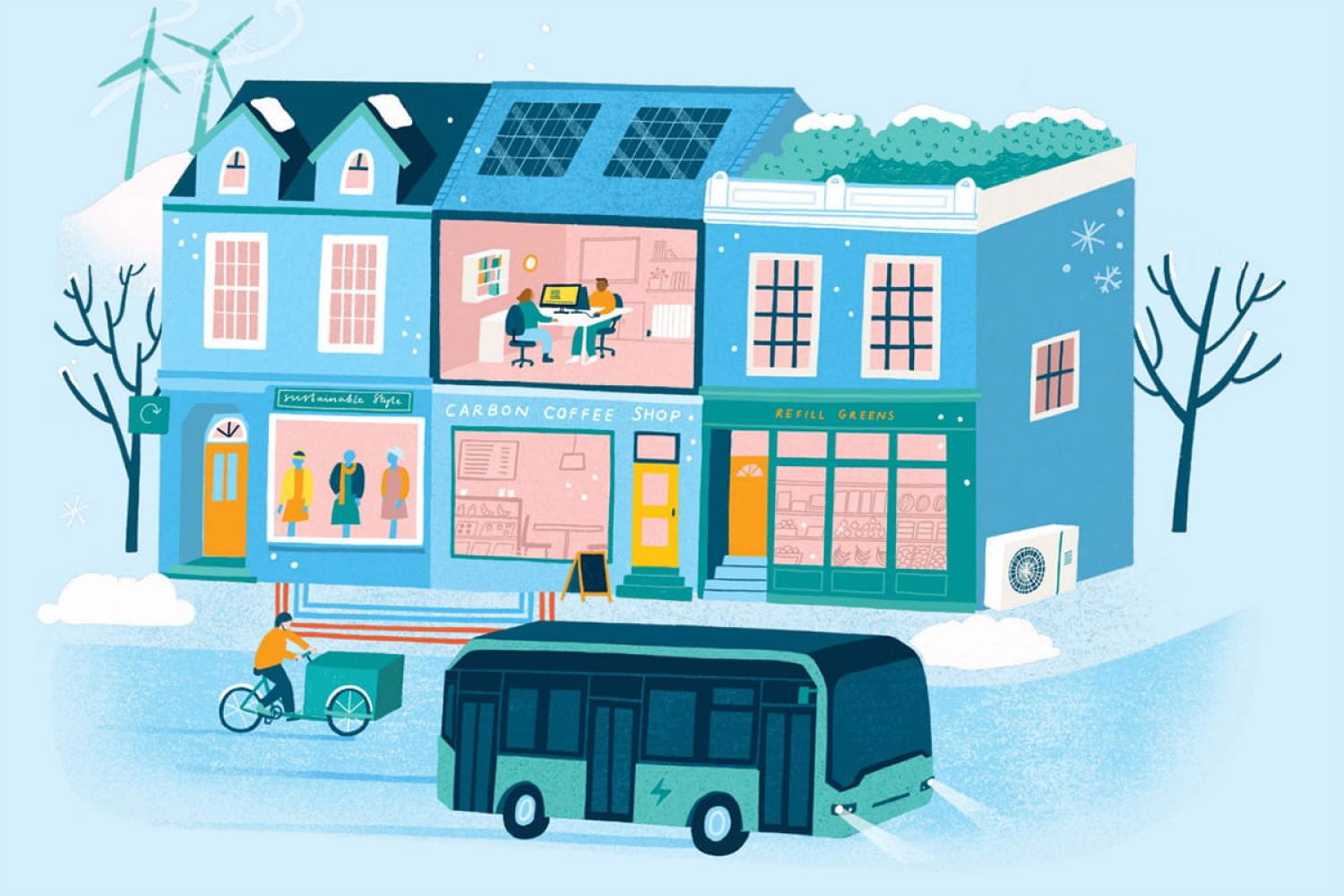
It’s a Monday morning.
After finishing your breakfast, you set off for work by bicycle. It’s convenient enough – there's plenty of room at the office bike store and you never have to wait to use the shower in the staff changing rooms. Besides, the day doesn’t officially start until 9:15, meaning there’s no need to rush.
As you arrive, you wave hello to a group of colleagues, who travelled by various means: Linda by tram, George by bus, and Tariq wheeled, after dropping off the kids at school.
There’s already a buzz of activity outside the building. A small crowd has been drawn by the spectacle of electrical engineers on the roof fitting the last of the new solar panels, which quickly becomes the topic of conversation. Before long, the estates manager Angus is raving about how much he has saved on electricity bills since getting panels at home and enthusiastically recommending the engineer he used. Your interest piqued, you ask him to share their contact details and leave to lock up your bike.
You're glad when you finally get inside – how come the office building is so much toastier than your draughty flat? This question is promptly answered when your email inbox pings with a reminder about this month’s free info session, happening this afternoon, about the building’s ground-source heat pump. You probably don’t have space for one yourself, but you recall that your parents said they were thinking of replacing their boiler soon, so hit ‘going’ on the invitation.
Not long after midday, raised eyebrows and the exchange of knowing looks indicate that it's lunchtime. You all gather your coats and walk across the road to Field Fare, the staff canteen shared by around a dozen neighbouring businesses and open to the public. While the plant-based menu isn’t your first choice, the generous staff discount and lively atmosphere is hard to resist. You sit down to a steaming hot sweet potato and chickpea curry with rice.
Workplaces have potential to be pioneers in the net zero transition
Importantly, this goes beyond businesses, charities and public sector bodies simply reducing their own greenhouse gas emissions, though this is an urgent task – SMEs combined were responsible for around a third of the UK’s total emissions in 2024.
As the scenario above imagines, workplaces that make their climate change mitigation efforts visible could help to influence employees (and their families and friends) to adopt net zero technologies and make low-impact choices the norm.
In-person workplaces can make efficient use of energy, too. The task of decarbonising daytime electricity and heating is far simpler when said energy consumed on a single premises, instead of hundreds.
Just as importantly, the net zero workplace imagined here could benefit people directly in many other ways: from better physical and mental health to reduced social isolation and food insecurity.
This article makes the case that organisations with a significant employee base and physical premises can leverage their influence and infrastructure to speed up the UK’s net zero transition.
Efficiency and simplicity
In simple terms, it is more efficient to heat and power a single, high-occupancy office building than hundreds of individual properties with staff working remotely.
This was the conclusion of research by London consulting firm WSP, which found that over a year, working from home in the UK produces 80% more emissions on average per employee than office working. This is because in winter months, people working at home tend to heat their whole homes, which vastly outweighs the carbon savings from not commuting in vehicles.
A similar logic applies to retrofitting buildings with clean energy. It is generally easier and quicker to retrofit a single commercial premise with roof and wall insulation, rooftop solar panels and a heat pump than it would be to do the same for hundreds of individual residential properties. While not always straightforward, upgrading a single premise still requires in total far fewer decision-makers, administration and scaffolding. Commercial buildings also tend to be newer than residential, making retrofits technically simpler than working with the UK’s ageing housing stock.
Workplaces that consume a lot of heat, such as leisure centres or distilleries, can also support the decarbonisation of their wider community by acting as core users (or ‘anchor loads’) of district heating networks.
And given the need to make deep and rapid emissions cuts, all of this helps to buy time for policymakers to tackle the more complex challenge of switching private homes to green heating and electricity.
Net zero influencers
As suggested in the imagined scenario above, workplaces can leverage their influence over potentially hundreds of individual employees and thousands of customers to encourage uptake of clean technologies and low-impact behaviours.
This is not just about leading by example. A business could enlist a ‘green team’ of employees who are empowered to use several paid hours a week to investigate, propose and organise a package of retrofits (e.g. EV charging points, solar panels and a heat pump) for the premises. By going through this process at their workplace, they may well feel far more capable of doing the same at home.
Crucially, these ‘ambassadors’ could then run demonstrations and information sessions about heat pumps, for example, for other staff and external groups. Someone considering getting a new gas boiler for their home might think twice if they know several colleagues have first-hand experience in managing the switch to a heat pump and can offer advice.
The same goes for serving plant-based meals at a staff canteen. A wholesale shift to plant-rich diets in wealthy countries is needed to reduce the food-related emissions driving global heating. Meat-free nudging, with suitable incentives such as a staff discount, can help to make plant-rich diets the default. Research into behavioural science suggests that workplace pro-environmental practices and norms can spill over into the domestic setting, and vice versa.
Given that SMEs employ around 60% of all private sector workers in the UK, they have significant potential to become net zero influencers in their community.
Quality-of-life benefits
As the warming and spicy sweet potato and chickpea curry enjoyed by the fictional protagonist above hopefully demonstrates, there is more to life than carbon.
Having access to a plant-based canteen is first and foremost an excellent staff benefit. Employees who might otherwise buy unhealthy supermarket meal deals or expensive takeaways (and who may not have the time to prepare a packed lunch) can enjoy an affordable, nutritious, hot meal. The fact that it is packaging-free and plant-based is likely to be seen as secondary to the social benefit.
Commuting to work by cycling, walking, wheeling or electrified public transport is widely understood to be good for our mental and physical health. Active travel in particular is associated with lower instance of obesity, diabetes, hypertension, as well as improved self-esteem and sense of wellbeing.
Being able to do so is, of course, dependent on having good local transport infrastructure and reasonable distances between staff homes and the workplace. But where it is feasible, businesses can make active and communal travel more attractive by providing secure bike storage, showers and changing facilities, flexible start times, and public transport allowances.
Similarly, many businesses do not have the resources to provide on-site catering, but could partner with local plant-based eateries and neighbouring employers to negotiate discounts. Indeed, research into SME energy efficiency networks in Germany found that companies prefer “collective action” to going it alone.
Conclusion: workplaces can become models for net zero
The role of organisations, and particularly SMEs, in responding to the climate and nature emergency has typically been limited to reducing greenhouse gas emissions from their operations and supply chains.
This overlooks the influence that many organisations have as both places where staff spend most of their time and as trusted voices in their community. By leveraging this, workplaces can model some of the transformations we need across the rest of society to create a liveable future.
There are encouraging signs. Our experience of running the Climate Springboard net zero training programme has shown us that many SMEs want to exercise that influence; to enable their staff, suppliers and customers to make low-impact choices. Our task now is to help more businesses to see that the scenario described in the introduction is well within reach.
Learn more about Climate Springboard
Climate Springboard is a free business support programme for SMEs in Scotland.
Get involved with Climate SpringboardFurther reading
- British Business Bank, SMEs and Net Zero UK Net Zero Business Census Report
- The Lancet, The EAT-Lancet Commission on healthy, sustainable, and just food systems
- NESCAN Hub, District Heat Networks
- Office for National Statistics, Age of the property is the biggest single factor in energy efficiency of homes
- PLOS One, Can work climate foster pro-environmental behavior inside and outside of the workplace?
- UK Green Building Council, Domestic Retrofit
- University College London, Journeys of walking and cycling improve physical and mental health across the life course
- University of Birmingham, Lunch meal deals: Good for the wallet but not the waistline - study
- Verfassungsblog, Meat-Free Nudging
- Walk Wheel Cycle Trust, The Role of Active Travel in Improving Health Toolkit Part 3: The role of active travel in improving mental health
- WSP, Office vs Home Working: How we can save our carbon footprint

Mhairi Cochrane
Programme Manager, Climate Springboard, University of Edinburgh

Joe Coroneo-Seaman
Copywriter, Climate Springboard, University of Edinburgh